2025 State Sessions Recap: The Busiest & Most Effective States
By Lydia Stowe and Lala Xu

Federal headlines may dominate the news cycle, but the real action often takes place in state capitols, where fast-moving sessions and packed agendas require constant vigilance from government affairs and advocacy professionals.
This year was no exception. Lawmakers introduced a flood of bills across a wide range of issues, keeping government affairs professionals in high gear from January through June.
Now that nearly every state legislature has wrapped up its 2025 session, it’s the perfect time to step back and examine where legislative activity was most intense, and which states were most productive.
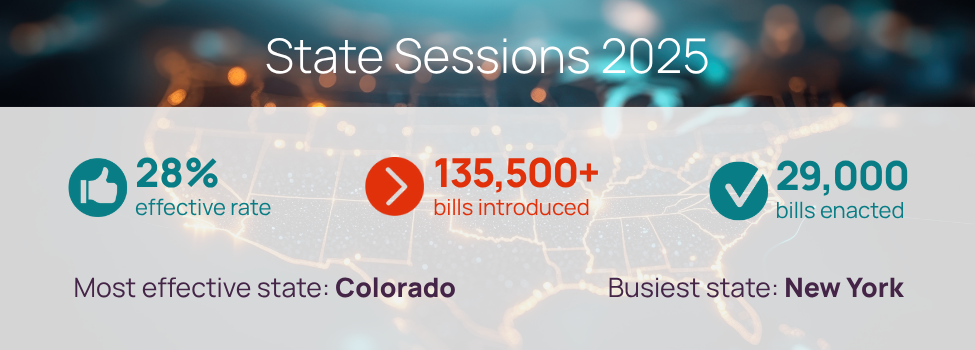
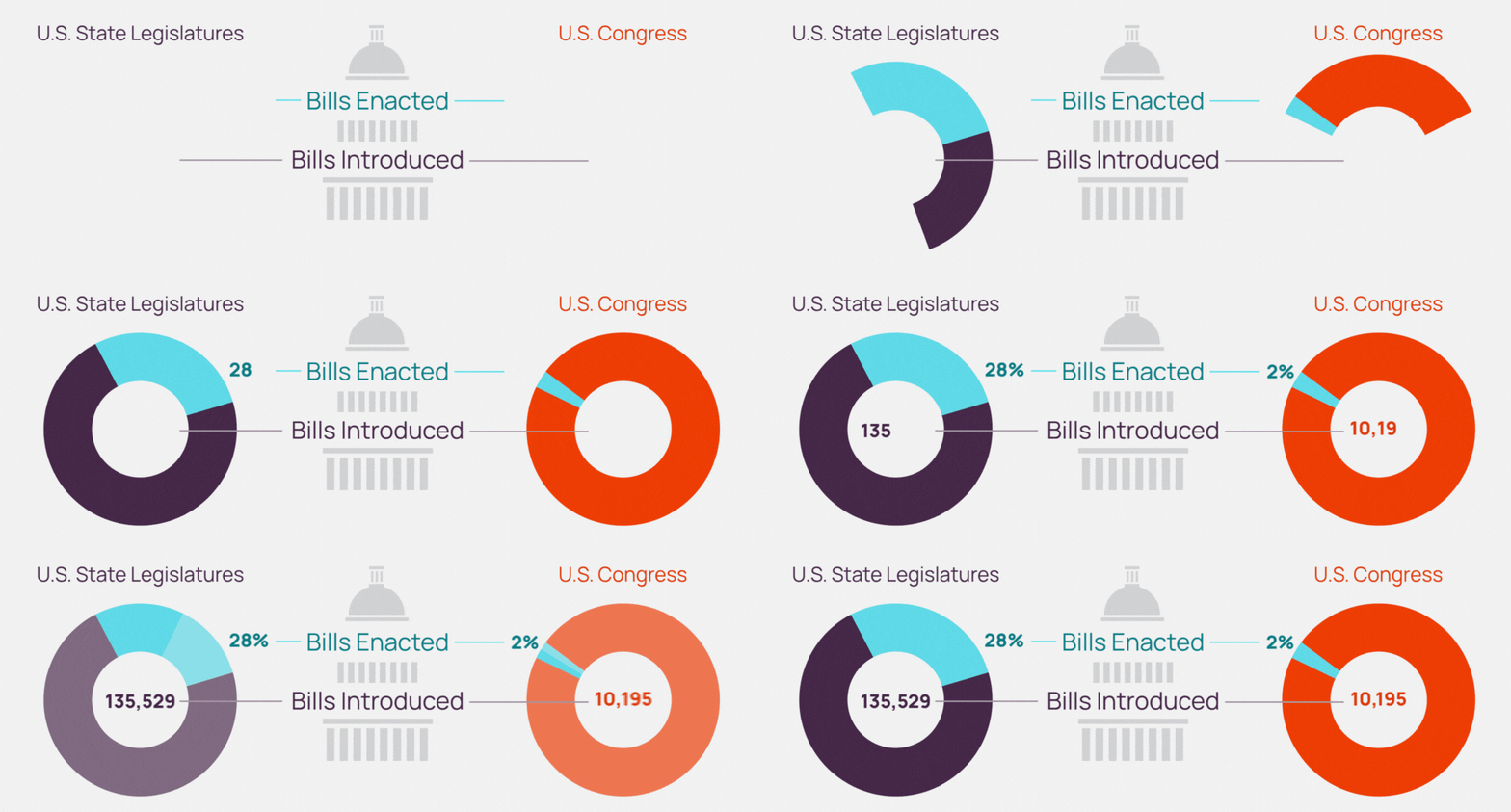
The pace of legislation surged in 2025, with the statehouses across the nation introducing more than 135,500 bills. The United States Congress, meanwhile, has introduced just over 10,000 bills in 2025, and only 2.3 percent of those bills were enacted. Congress had a lower effective rate than all but four states, which is something to ponder as you lay out your legislative strategy.
State Legislation Introduced in 2025
States introduced more than 135,500 bills in 2025. That was an increase of around 55 percent from the 87,500 bills introduced in 2024.
This is in part because some states (Montana, Nevada, North Dakota, and Texas) have no even-year legislation. Those four states combined introduced more than 13,000 bills: More than 9,000 in Texas, over 1,800 in Montana, more than 1,000 in Nevada and North Dakota.
Some states saw their numbers rise in 2025. New Hampshire introduced 990 bills this year, a huge jump compared to last year’s 31 bills. Oregon, Maine, and Arkansas introduced many more bills compared to previous years.
The state with the steepest drop in introduced legislation was New Jersey. In 2025, New Jersey introduced only about 1,500 bills, compared to more than 8,750 in 2024 — an 83 percent decrease.
New York lawmakers introduced the most bills by far in their 2025 session, with 18,800+ pieces of legislation. But only 2,301 of those got enacted, for a 12 percent effectivity rate.
Special Sessions
Of the 135,500 bills the states introduced in 2025, about 420 came from the special sessions held in seven states (California, Tennessee, Florida, Missouri, Minnesota, Mississippi, and Virginia). Overall, special sessions had a 47 percent effectivity rate, significantly higher than the overall state average of 28 percent.
How Many Bills Did Each State Introduce in 2025?
Hover to see the number for each state
State Legislation Enacted in 2025
States saw an average effective rate of 28 percent this year, enacting nearly 29,000 bills. That’s a slight increase from 2024 sessions, which saw an average effective rate of 26 percent and over 21,000 bills enacted.
Texas passed the most legislation, with more than 3,200 bills enacted this year.
How Many Bills Did Each State Enact in 2025?
Hover to see the number for each state
Which state had the highest effective rate? Colorado topped the list with 74 percent of bills passed, while Massachusetts claimed the bottom spot with 0.1 percent of legislation passed. However, it’s worth noting that Massachusetts’ session adjourns much later than the majority of other states and will be in session until January 6, 2026. In fact, eight states — California, Massachusetts, Michigan, New Jersey, North Carolina, Ohio, Pennsylvania, and Wisconsin — have yet to adjourn their 2025 session.
About half the states fell somewhere in between, passing between 10 and 50 percent of their proposed laws.
Colorado passed the most legislation relative to the amount it introduced. The Centennial State introduced over 730 bills and enacted 539 of those — 74 percent effective.
Colorado’s high bill passage rate comes down to a combination of structural and political factors, according to Rep. Alex Valdez, who represents Denver in the Colorado House. “We have a strong Democratic majority, so it’s easier to move legislation,” Valdez says. “Our committees reflect that same makeup, which cuts down on the partisan gridlock you see in more closely divided states.”
He noted that a significant portion of the bills introduced each year — around 60 percent — are clean-up measures, statutory revisions, or bill updates, which are usually noncontroversial and more likely to pass. “When it comes to the big policy debates, maybe 100 bills a year really carry the weight, and those are the ones more likely to fail,” Valdez says.
Which State Passed the Highest Percentage of Bills Relative to the Number Introduced?
Hover to see the number for each state
All Data
Hover to see the number for each state
The 15 Busiest States in 2025
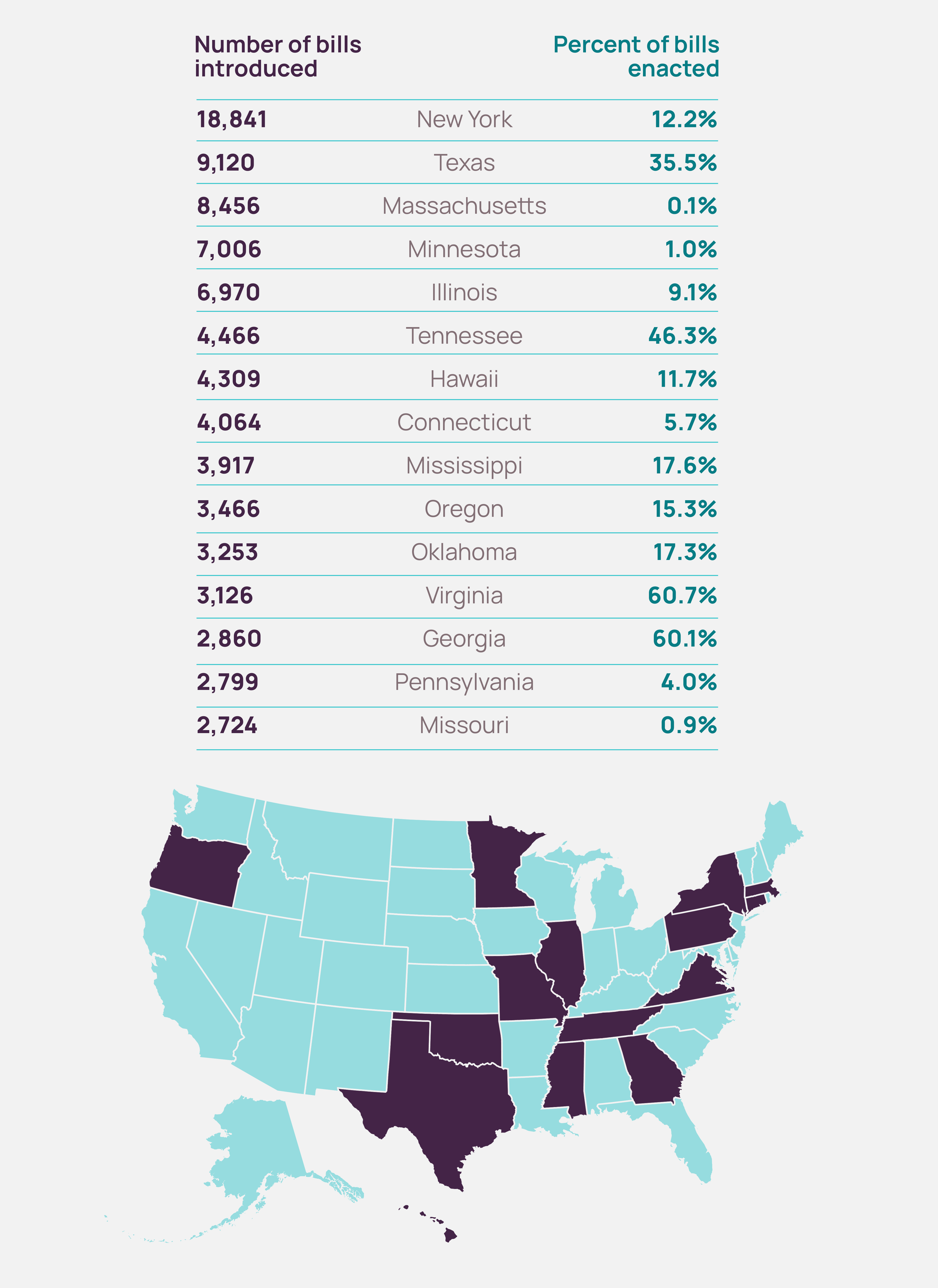
In terms of sheer numbers, New York, Texas, and Massachusetts top the list of the busiest states, but other states had busy sessions as well. Minnesota weighed in with more than 7,000 and Illinois wasn’t far behind with 6,790.
Here are the 15 states that introduced the most legislation in 2025, along with their effectiveness rate.
Does Party Control Impact Legislative Effectiveness?
The composition of state governments can significantly influence how efficiently legislation moves through the pipeline. States with unified party control — commonly called “trifectas” — tend to have higher enactment rates than those with divided government.
In 2025, Republican trifecta states stood out with an average effectiveness rate of 36.4 percent, well above the national average of 28 percent. By comparison, Democratic trifecta states averaged 19.8 percent, and split governments lagged behind at just 18.6 percent.
Twelve states had split governments in 2025, and nine of them had below-average enactment rates. While gridlock is more common when power is divided between parties, the data suggests that Republican trifectas are consistently more effective at moving legislation across the finish line.
Ready to spend less time reading and more time leading?
Designed for busy government affairs professionals, PolicyNote gets you out of your inbox and into the rooms where decisions happen.