


As a product manager on FiscalNote's PolicyNote team, part of my job is finding technology that helps our customers do their work better. Lately, I've been focused on how government affairs teams use AI tools and what changes when those tools can draw on policy data.
When I talk to customers about connecting PolicyNote data to Claude or ChatGPT, I often hear: Why can't I just use the AI tool as is? It's a fair question. Either tool will answer a policy question. But a fluent answer doesn't tell you whether the bill status is current or whether the sources actually fit what you asked.
To illustrate this, I put three policy questions to Claude with and without access to PolicyNote data. The answers showed how easily a response that sounds useful could send a policy team in the wrong direction.
How I Ran the Comparison
I chose three policy questions a government affairs team might ask Claude. I ran each prompt twice: first without a PolicyNote connection, then with PolicyNote MCP enabled.
MCP stands for model context protocol. It lets Claude draw on PolicyNote's legislative and regulatory data while answering. I kept the model and prompt wording the same for each pair of runs.
Test 1: The Status of California AB 1018
The question: Which bills introduced this session in California would create new requirements for employers using AI in hiring or screening?
Without PolicyNote MCP, Claude identified AB 1018 but said the bill was dead, but claimed it had missed an August 31 deadline and would need to be reintroduced as new legislation.
With the MCP, Claude identified AB 1018 and reported that it had been amended and moved to third reading in the Senate as of August 30.
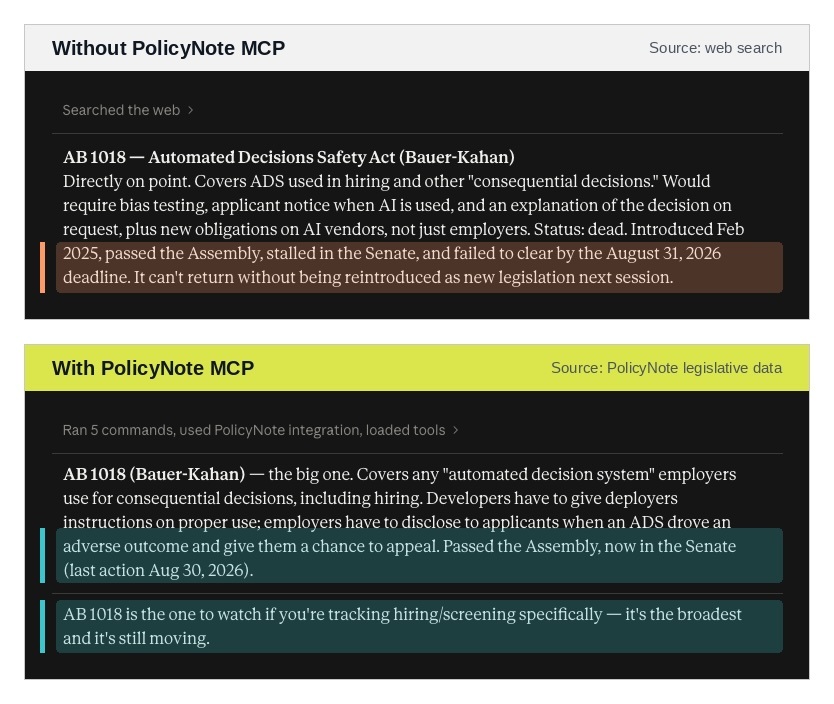
I checked the California Legislature's bill history and confirmed that AB 1018 was still moving. An analyst who accepted the first answer could have removed a live bill from their monitoring list.
Without the MCP connection, Claude answered using general information available to it, which can include outdated or unverified sources. PolicyNote MCP gave it access to legislative data our team maintains and updates as bills move. Maintaining accurate, current policy data is PolicyNote's job. This is also the value behind PolicyNote's AI assistant.
In this test, the connected answer reflected the bill's latest action. The unconnected answer called it dead.
Test 2: Comment Periods Affecting Healthcare Providers
The question: What federal rulemakings open for public comment right now affect healthcare providers?
Without PolicyNote MCP, Claude found two real, correctly dated federal dockets. One concerned disclosures by group health plans. The other concerned how vaccine recommendations are categorized. Neither addressed healthcare providers.
With the MCP, Claude returned eleven open comment periods from the current CMS docket. It brought forward draft guidance on the Medicare drug price negotiation program, with two days left to comment, and a Medicare Transaction Facilitator update for 2028. It flagged an FDA citizen petition about AI systems performing physician-level medical functions. It identified the petition as something to watch, not a rulemaking.
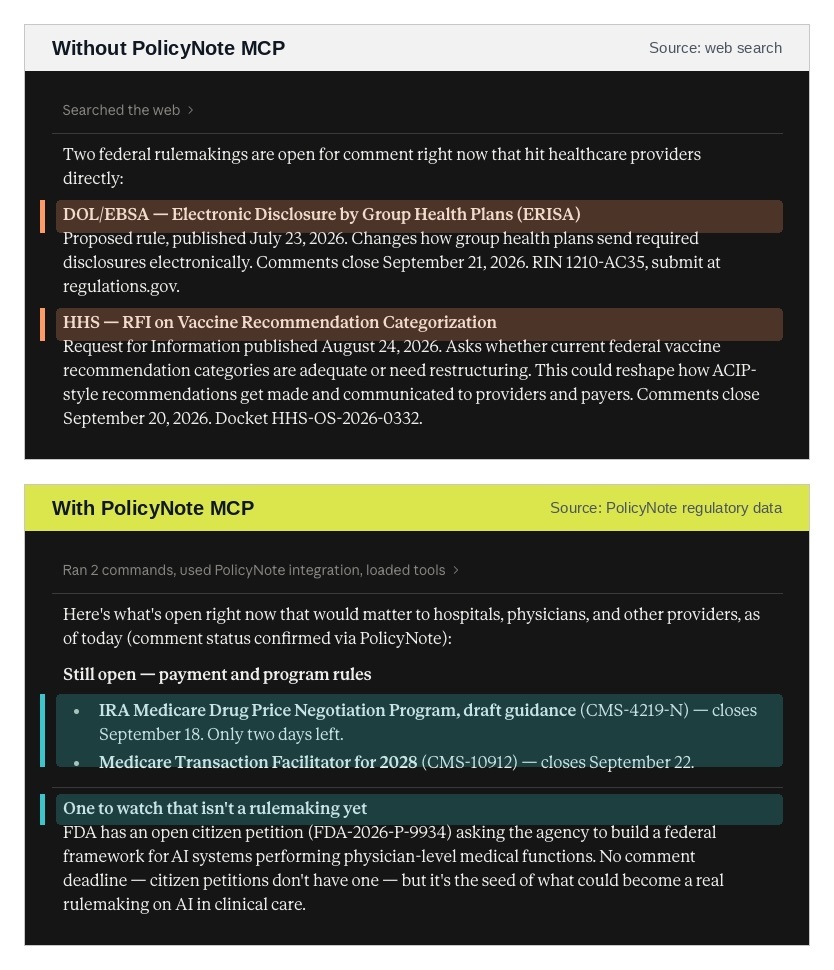
The first answer returned real, correctly dated dockets, but neither addressed healthcare providers. The connected answer surfaced more relevant CMS activity and identified the FDA item as a petition. I would still check which items qualify as rulemakings before using them in a briefing.
Relevance is one of the things our engineers evaluate when testing PolicyNote MCP for government affairs work. They check whether it retrieves the right policy document and whether the answer uses the right terminology. They also look for unsupported claims and whether a GA professional could use the output. That ongoing evaluation helps explain why the second answer was more useful for this question.
Test 3: Energy Legislation Affecting the Gulf Coast
The question: Which members of Congress are most active on energy legislation affecting the Gulf Coast, and what are they pushing?
Without PolicyNote MCP, Claude named Senator Bill Cassidy as the most active. It cited the RISEE Act and gave a specific revenue-cap figure attributed to “Cassidy’s office.”
With the MCP, Claude also named Cassidy as the most active and pointed to a bill he introduced last year that was still pending, along with its cosponsors.
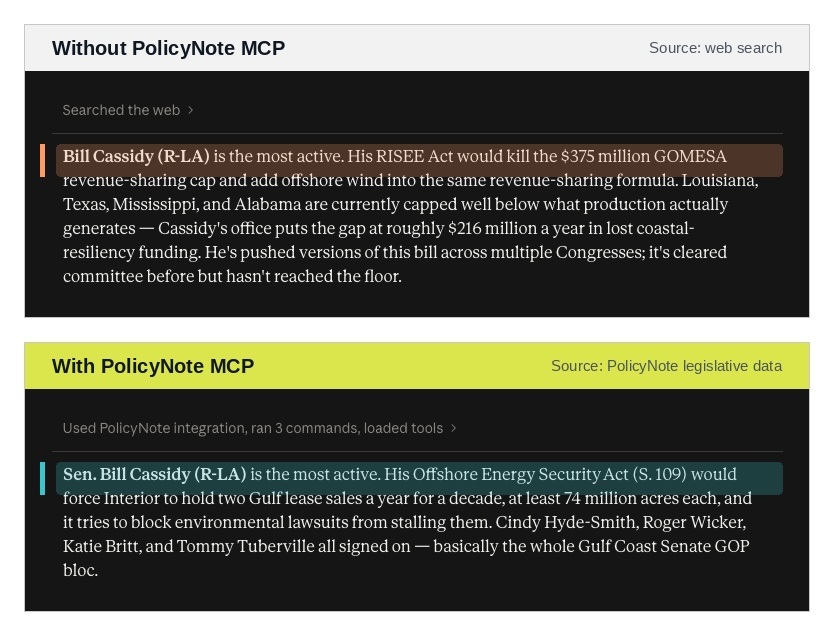
I checked the legislative history behind the first answer. No RISEE Act exists in this Congress, and the earlier bill had not been reintroduced. Its specific revenue figure made the answer sound well researched, but an analyst could have carried an older bill into a briefing as current legislation.
With PolicyNote MCP, I could see which records Claude consulted and its stated reason for selecting the pending bill. Without it, I only had source links, so I had to reconstruct how Claude arrived at the RISEE Act. That visible paper trail made the connected answer easier to check before sharing it.
What This Changes in Day-to-Day Policy Work
For me, the payoff is a better first draft of monitoring summaries and stakeholder updates. When Claude can draw on maintained policy data, GA teams can start a monitoring summary with a more reliable account of what is happening. They can also trace the answer back to its sources before sharing an update.
That paper trail is useful when someone asks why a bill is on the watch list. The analyst can return to the record and explain the finding. They still need to check what has changed since the first draft, but they can spend less time reconstructing the research and more time deciding what deserves attention.
Claude will answer a policy question with or without a data connection. In these tests, connecting it to PolicyNote gave me a stronger starting point and a clearer way to check the answer. To see how it works with the issues your team tracks, request a PolicyNote MCP demo.